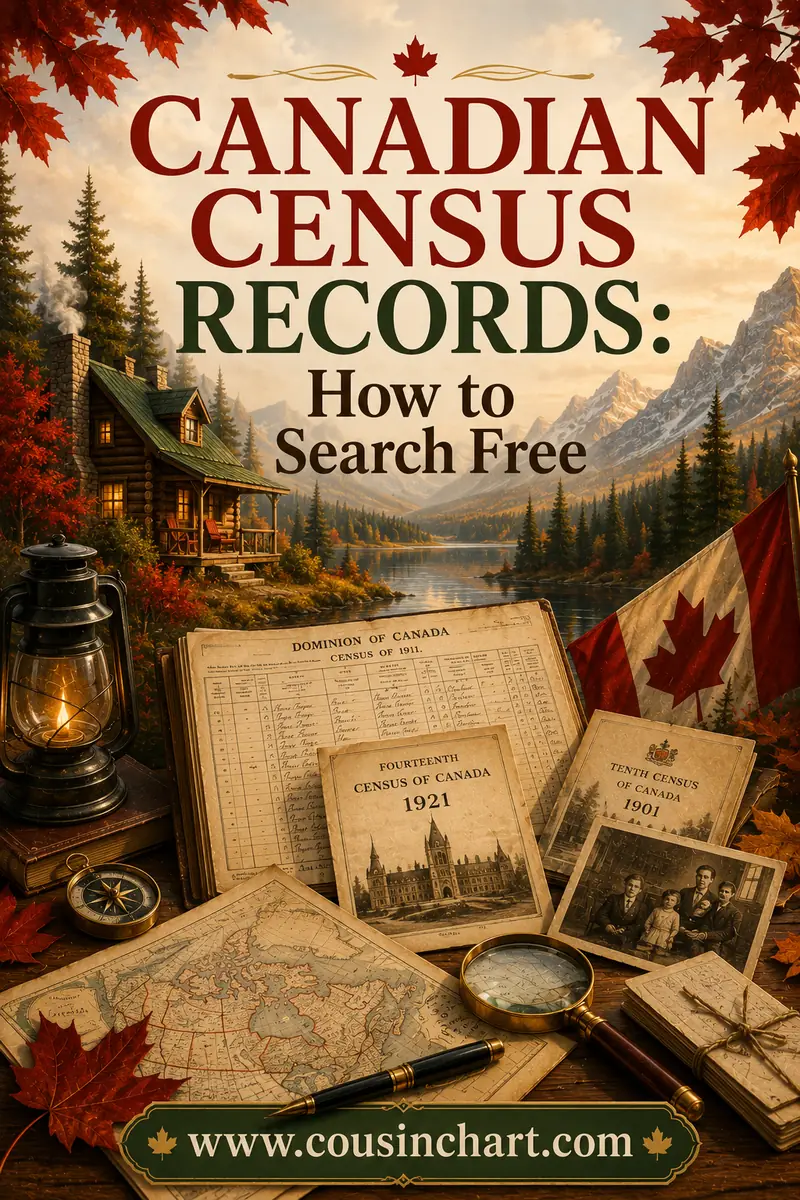
Canadian Census Records: How to Search Free
Every public Canadian census — 1825 through 1931 — is searchable free at Library and Archives Canada (LAC), the country's national archive, with digitized images included. FamilySearch mirrors most of the indexes free as well. Canada releases each census 92 years after it was taken, so the newest available is 1931 (released June 1, 2023), and 1941 arrives in 2033.
For anyone with Canadian ancestors — or American ancestors who slipped across the border for a generation, which is more families than you'd think — the Canadian censuses are unusually generous: they record religion, ethnic origin, year of immigration, and in 1901 even exact birth dates. This guide covers what exists, what each census asked, and how to search it all without paying a cent. And when the household you find is a tangle of in-laws and step-children, the free relationship calculator on our homepage sorts out who's what to you.
Which record should I search? Tap your ancestor’s situation to see the right Canadian record and where it’s free.
Tap a button above to get a starting point.
Map how you're related to them →What exists: the Canadian census timeline
| Census | Coverage | Notes |
|---|---|---|
| 1825, 1842 | Lower/Upper Canada (partial) | Heads of household only in early counts |
| 1851/52, 1861 | Province of Canada, Maritimes | Every name; some losses |
| 1871 | ON, QC, NB, NS | First Dominion census |
| 1881, 1891 | Nationwide | Full names, origins, religion |
| 1901 | Nationwide | Exact birth dates recorded |
| 1906 | MB, SK, AB | Special prairie census |
| 1911 | Nationwide | Released 2005 |
| 1916 | MB, SK, AB | Prairie census |
| 1921 | Nationwide | Released 2013 |
| 1926 | MB, SK, AB | Prairie census |
| 1931 | Nationwide | Released June 2023 — newest available |
All of it is free at Library and Archives Canada — search "Census search" from the LAC genealogy pages — and most collections are also indexed free on FamilySearch.
Note the rhythm: a national census every ten years, plus extra censuses of Manitoba, Saskatchewan, and Alberta every five years (1906, 1916, 1926) while the prairies were filling with homesteaders. If your people were prairie settlers, you get twice the snapshots.
The 92-year rule
Canada's Statistics Act opens each census to the public 92 years after enumeration. That put 1921 online in 2013 and 1931 online in June 2023 — released through a collaboration in which LAC digitized the images and worked with commercial partners on AI-assisted indexing, with the result searchable free on LAC's own site. The 1941 census follows in 2033.
(For comparison: the US uses a 72-year rule — its 1950 census is already public — and Britain uses 100 years, covered in our UK census guide.)
What Canadian censuses ask that others don't
American researchers who cross into Canadian records are usually delighted. Typical columns include:
- Religion — every census. Denominational detail ("C. of E.," "R.C.," "Presbyterian," "Mennonite") points you directly to the right church registers.
- Racial or ethnic origin — the "origin" column ("Irish," "Scotch," "French," "German," "Ukrainian") preserves the family's identity generations after immigration.
- Year of immigration and naturalization status — a dated arrival to chase into passenger lists (see our free immigration records guide).
- Exact birth date in 1901 — day, month, year. No other census in North America did this. Treat it as gold, verified against church records where possible.
- Language columns — French/English (and mother tongue later), useful for tracking francophone families outside Quebec.
- Earnings, months at school, and infirmities in various years — texture that turns a name into a person.
How to search, step by step
- Start at LAC's census search. One search box covers every released census. Enter surname, given name, and an approximate age or birth year; filter by province.
- Try FamilySearch second. Its indexes were made independently for many years, so it finds names LAC's index garbles, and vice versa. Free account required, nothing more.
- Open the image. Canadian enumerators packed the page — the index typically captures a tenth of the columns. Read the origin, religion, and immigration fields yourself.
- Walk the decades. Same discipline as US research: find the family in every census from 1931 back as far as they go, watching ages and birthplaces stay consistent.
- Branch into the sister records. The census hands you the leads: year of immigration → passenger lists at LAC; religion → parish registers; prairie location → homestead land files at provincial archives.
Spelling and language pitfalls
French names took bruising anglicizations ("Boulanger" appearing as "Baker," "Lévesque" as "Levack"), Ukrainian and German names were spelled phonetically by English-speaking enumerators, and dit names — French-Canadian alias surnames, where one family might use either of two surnames interchangeably — can make a family "vanish" between censuses. Search both forms, search phonetically, and when a household's composition matches but the surname doesn't, trust the household.
Beyond the census: what else is free at LAC
Once the censuses have sketched your Canadian family, Library and Archives Canada keeps feeding the tree at no charge:
- Passenger lists and border entries — arrivals at Quebec, Halifax (including the Pier 21 era), and other ports, plus records of people crossing into Canada from the US.
- Home Children records — over 100,000 British children were sent to Canada as indentured farm help between 1869 and the 1930s; LAC's free databases document many, and it's a common surprise ancestor.
- Soldiers of the First World War — the complete digitized service files of the Canadian Expeditionary Force, free, every page. If your Canadian ancestor was male and born in the 1880s–90s, check this before anything else; the files are extraordinary.
- Land grants and homestead files — Western land patents and Ontario/Quebec grant indexes, tying census farmers to exact parcels.
- Divorce, citizenship, and Loyalist sources — smaller but searchable.
Provincial archives carry the vital records (civil registration is provincial in Canada), and most have free online indexes — Ontario, British Columbia, and Nova Scotia are especially generous with digitized certificates.
French Canada: the parallel goldmine
If your line runs through Quebec, the census is almost the second-best source. Catholic parish registers — baptisms, marriages, burials — run back to the 1600s with extraordinary completeness, and marriages name both spouses' parents, letting you chain generations quickly. FamilySearch hosts vast indexed collections free. Many French-Canadian researchers assemble ten or more generations, at which point cousin math gets genuinely silly — third cousins twice removed on four different lines. That's precisely the moment to lean on the free CousinChart calculator, which names any relationship no matter how deep the tree goes.
FAQ
Are Canadian census records really free?
Yes. Library and Archives Canada hosts every released census (1825–1931) with free name searches and free images — no account, no fee. FamilySearch offers free parallel indexes. Commercial sites carry the same censuses but aren't required.
What's the newest Canadian census I can see?
The 1931 census, released June 1, 2023 under Canada's 92-year privacy rule. It's searchable free at Library and Archives Canada. The 1941 census becomes public in 2033.
Why do Manitoba, Saskatchewan, and Alberta have extra censuses?
The prairie provinces grew so fast during the settlement era that Canada counted them every five years — special censuses in 1906, 1916, and 1926 in addition to the national counts. All three are released and free.
Which Canadian census is best for genealogy?
The 1901 census, for one killer feature: it recorded each person's exact date of birth, not just an age. The 1931 census is the richest for recent generations, and 1871 anchors families at Confederation.
My ancestors moved between Canada and the US. Which records do I check?
Both countries' censuses — many families appear in a Canadian census one decade and a US census the next. Add US–Canada border-crossing records (indexed on FamilySearch) and each country's naturalization files. The census "year of immigration" column tells you when to look.
Are any Canadian censuses missing or incomplete?
Yes, mostly the early ones. The 1825 and 1842 censuses named heads of household only, and portions of the 1851/52 returns didn't survive — so a family genuinely present can still be absent from the record. If a search comes up empty pre-Confederation, bracket the gap with the 1861 and 1871 censuses and lean on parish registers, which often cover the same years completely.
Do I need to read French to use Quebec records?
Not really. Parish register entries follow a rigid formula — baptême, mariage, sépulture, plus names, dates, and parents — so once you've decoded one entry you can read a thousand. FamilySearch's free wiki has word lists for the tricky bits.
How do I work out relationships in a big Canadian household?
The census states each person's relationship to the household head only. To translate "my great-grandmother's half-brother's daughter" into an actual term — half first cousin once removed, as it happens — use the free relationship calculator and let it do the counting.
Your Canadian branch is waiting
Canadian census research is about as friction-free as genealogy gets: one national archive, every census free, images included, and indexes on two independent sites. Start at Library and Archives Canada with the 1931 census, walk backward decade by decade, and follow the religion and immigration columns into the deeper records. And as the tree fills with prairie homesteaders and Quebec parishes, keep the free CousinChart relationship calculator open — it turns any tangle of relatives into plain English.