How to Find Your Last Name's Origin and Meaning
The single mistake that wrecks most surname research: looking up the meaning before working out what kind of name it is. Every surname belongs to one of four categories — patronymic, occupational, locative or descriptive — and each category needs a different source to answer it. Get the category right and the meaning usually follows in ten minutes; get it wrong and you will spend an afternoon reading confident nonsense. The second thing worth knowing before you start: a surname meaning is never proof of descent. Common names arose independently in dozens of places, so sharing a name with a documented family means nothing on its own. Here is the method that actually works, and to map the relatives you find along the way, use the cousin calculator.
What kind of name are you starting with? Tap the closest match.
Tap an option above. The category decides which source can answer you.
Step one: identify the category before the meaning
This is the whole method in one move. Almost every European surname falls into one of four buckets.
| Category | How to spot it | Examples | Where to look it up |
|---|---|---|---|
| Patronymic | prefix or suffix meaning "son of" | Johnson, Petersen, Ivanov, MacLeod, Fernández, Papadopoulos | dictionary of given names for the root |
| Occupational | a trade, office or tool | Smith, Cooper, Meyer, Kowalski, Sarto, Le Goff | historical trade glossary in the right language |
| Locative | a settlement, region or landscape feature | Bradford, Da Vinci, Van Dijk, Lipsky, Trelawney | place-name dictionary or national gazetteer |
| Descriptive | color, size, temperament, animal | Brown, Klein, Petit, Bianchi, Kaplan | historical dialect dictionary — hardest to verify |
Patronymics need the father's name looked up, not the surname. Johnson does not have a meaning beyond "John's son"; the meaning you want belongs to John. The full mechanism across languages is in patronymic surnames.
Occupational names often name jobs that no longer exist. Fletcher made arrows, Chandler made candles, Wainwright made wagons. A modern dictionary will not help; a medieval trade glossary will. The catalog is in occupational surnames.
Locative names are best answered by place-name scholars, not surname sites. The English Place-Name Society county volumes, and their equivalents elsewhere, are rigorous, cite manuscript evidence, and give earliest recorded forms.
Descriptive names are the least reliable category. Meanings depend on dialect, and the same word could be literal or ironic. Treat any confident single answer for a nickname surname with suspicion.
Some names sit in two categories. Church could be a place (a man who lived by one), an occupation (a man who worked for one) or an office. Multiple origins for one spelling is normal, not a puzzle to solve.
Step two: find the earliest spelling you can document
The modern spelling is the least informative version of your name.
Work backwards through records rather than guessing. Each generation you push back usually produces one or two more spellings, and the older form is closer to the original word.
Aim for a pre-1800 form in the home country. Anything earlier is a bonus. Parish registers, wills, land records and tax rolls are the usual sources; the practical mechanics of working through them are in how to search census records.
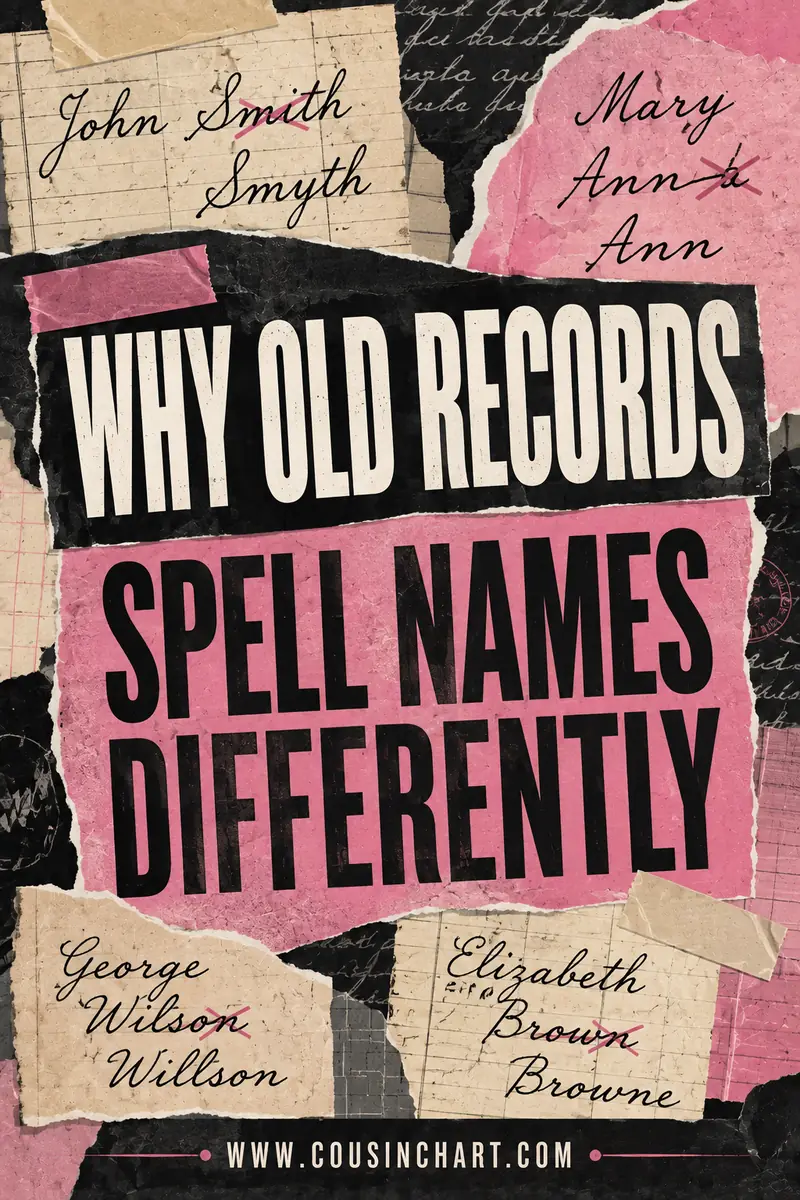
Expect the same person to appear under different spellings. A man could be Wolfe, Woolf and Wolff across three documents in one decade, all written by clerks who never asked him. That is normal and not evidence of anything — the causes are set out in surname spelling variations.
Watch for Latin in older registers. Willelmus filius Johannis is Latin dressing over an English reality, and Fabri is a Latinised Smith. Do not read the Latin as the family's own form.
Note every variant you find, in a list. You will need them for the distribution work in the next step, and for wildcard searching later.
Do not stop at the first spelling that matches a meaning you like. That is the most common way people talk themselves into a wrong origin.
Step three: check historical distribution, not modern
This is the step that separates a real answer from a guess, and almost nobody does it.
Modern distribution is scrambled by two centuries of migration. A name that is now spread evenly across the United States or Australia may have come from three villages in one county.
Historical distribution is not. Maps built from nineteenth-century censuses, civil registration indexes or old telephone directories show where a name clustered before mass movement.
A tight cluster usually means a single origin. If a surname concentrates in one district in 1841 or 1881, one family probably founded it there, and your line very likely descends from that district.
A scattered pattern usually means multiple independent origins. Smith, Miller, Baker and their equivalents in every language arose separately wherever the trade existed, so no single origin exists to find.
Several countries have free public surname atlases built on census or registration data, and there are Great Britain, Ireland, German, French, Spanish and Dutch versions among others. A cross-country comparison is exactly what what country is my last name from covers.
Distribution also catches convergent forms. Miller in England, Müller in Germany, Molnár in Hungary and Molinari in Italy are the same job in four languages, not one family. Distribution shows you which one you belong to.
Step four: use sources that cite their evidence
The quality gap between surname sources is enormous, and it is not obvious from the design of the websites.
Scholarly surname dictionaries are the gold standard. The major reference works give earliest attested forms with dates, county or region, and a discussion of competing derivations. They will say "origin uncertain" when it is.
National surname projects and university name studies publish research on their own country's naming and are usually free.
Place-name societies and gazetteers answer locative names properly.
One-name studies — groups researching every bearer of a single surname worldwide — often hold the best evidence for uncommon names, including distribution data and documented multiple origins.
Language dictionaries beat surname sites for occupational and descriptive names. A historical dictionary of the relevant language will tell you what fuller or chandler or kowal actually meant in period.
The test for any source is whether it says where it got its information. A page that gives a meaning with no earliest form, no date, no region and no alternative reading is repeating something it read elsewhere.
Why free "surname meaning" sites mislead
They are not all bad, but the failure modes are consistent enough to name.
They recycle each other. Ten sites agreeing is usually one nineteenth-century source, out of copyright, copied ten times. Consensus among them is not corroboration.
They give a single confident answer where scholarship gives two or three. Real etymology is often unresolved. A site that never says "disputed" is not being careful.
They flatten multiple origins into one. Presenting a common trade name as though it came from one founding family is the standard error, and it is exactly backwards.
They tie the meaning to a nationality too tightly. The same name frequently exists in several countries with separate origins.
And most of them are running a shop. The meaning is free; the coat of arms print, the scroll and the "family history" booklet are not.
On that last point, the honest version: no coat of arms belongs to a surname. Arms are granted to an individual and inherited by that person's documented descendants under defined rules. Sharing a surname with an armiger gives you nothing at all. There is a genuinely enjoyable alternative in make a family coat of arms.
Handling names that were changed
Very common, and it derails research more often than any other single factor.
Names were rarely changed at immigration desks. The Ellis Island story is a myth — clerks worked from passenger manifests written at the port of departure. Changes usually happened afterwards, by the family itself, over years.
Anglicisation took several forms. Phonetic respelling (Schmidt to Smith), translation (Zimmermann to Carpenter), truncation (Kowalczyk to Kowal or Cole) and outright substitution of an unrelated but similar-sounding name.
Look for the transitional period. Most families used both forms for a decade or two, so the same household appears one way in a census and another in a church record. Finding both is the proof.
Diacritics were dropped wholesale. Ó, ä, ü, ø, ł and ç vanish in English-language records, which changes both the spelling and the sound.
Some changes were deliberate concealment. Families escaping debt, conscription, conviction or persecution changed names on purpose, and left no paper trail linking the two. That is a research wall, not a failure on your part.
Work from how the name sounded. Say the original aloud with the original accent and consider what an English-speaking clerk would have written. That guess is often the search term that finds the record.
What a surname meaning does and does not prove
The boundary matters, because a great deal of money is made on the far side of it.
A meaning is a fact about a word. Bradley means "broad clearing". That is a statement about English vocabulary in about 900, and about a field.
It is not a fact about your family. It does not tell you that your ancestor lived at that clearing, only that some ancestor of somebody with that name did.
Shared surname is not shared ancestry. For common names it is overwhelmingly likely you are unrelated to any given namesake. Thousands of unrelated families carry every frequent surname in Europe.
A famous bearer of your name is almost certainly not your relative. Descent from a documented historical figure requires a documented line, generation by generation, with sources.
A DNA ethnicity estimate cannot confirm a surname origin either. Ethnicity percentages are population-level statistical inferences with wide margins, and they say nothing about the derivation of one word — the limits are laid out in DNA ethnicity estimates accuracy.
Only documents connect you to a line. Births, marriages, deaths, wills, land and church records. The surname meaning is decoration on top of that work, and it is a pleasure once the work is done.
The method in order
Run these in sequence and stop when you have an answer with evidence behind it.
One: write down every spelling you have ever seen for the name, including in records, on gravestones and in family memory.
Two: decide the category. Patronymic, occupational, locative or descriptive. If two are possible, keep both open.
Three: push the earliest documented spelling as far back as records allow, in the country of origin rather than the country of arrival.
Four: map historical distribution using a census-based atlas for around 1840 to 1900, for every spelling variant.
Five: look the root up in the right kind of dictionary for the category — given names, trades, places or dialect.
Six: check whether a one-name study exists. For an uncommon name this can save you months.
Seven: write down what you concluded and why, including the alternatives you rejected. Future you will want to know which parts rest on evidence and which on inference.
FAQ
What is the most reliable free way to find a surname's meaning?
A national surname distribution map plus a scholarly surname dictionary, used together. The map tells you where the name was concentrated before migration; the dictionary tells you what the word meant there. Neither alone is enough, and free meaning sites are neither.
Does my surname prove I descend from a particular family?
No. Most common surnames arose independently in many places from the same trade, landscape feature or father's name. Only a documented chain of records — births, marriages, wills, land — connects you to a specific line, and a shared name is a starting hypothesis at best.
Why do different websites give different meanings for my name?
Usually because the etymology is genuinely contested, or because one site has flattened several possible origins into one. Scholarly sources will list competing derivations and say which has better evidence. A single confident answer with no alternatives is a warning sign.
Can a DNA test tell me where my surname came from?
Not directly. Ethnicity estimates are population-level inferences with substantial margins and cannot speak to the origin of a word. A Y-DNA test can show whether two men sharing a surname share a paternal line, which is a different and much more useful question.
Was my family's name changed at Ellis Island?
Almost certainly not. Officials worked from manifests prepared at the departure port and had no authority to alter names. Changes overwhelmingly happened later, chosen by the family, and usually appear gradually across records over a decade or two.
Is there a real coat of arms for my last name?
No coat of arms has ever belonged to a surname. Arms are granted to individuals and inherited by their descendants under defined rules, so sharing a name with an armiger entitles you to nothing. The framed prints sold by surname sites are somebody else's arms.
Getting a real answer, not a flattering one
The difference between surname research that holds up and surname research that embarrasses you later is entirely in the order of operations. Categorize first, document the earliest spelling second, map the historical distribution third, and only then reach for a meaning — from a source that cites evidence and admits uncertainty. Keep the two questions separate throughout: what does this word mean, and who am I descended from. The first is answered by dictionaries and atlases, the second only by records. Nothing sold alongside a surname lookup answers either. Once you have the documents, the cousin calculator will tell you exactly how the people in them relate to you.