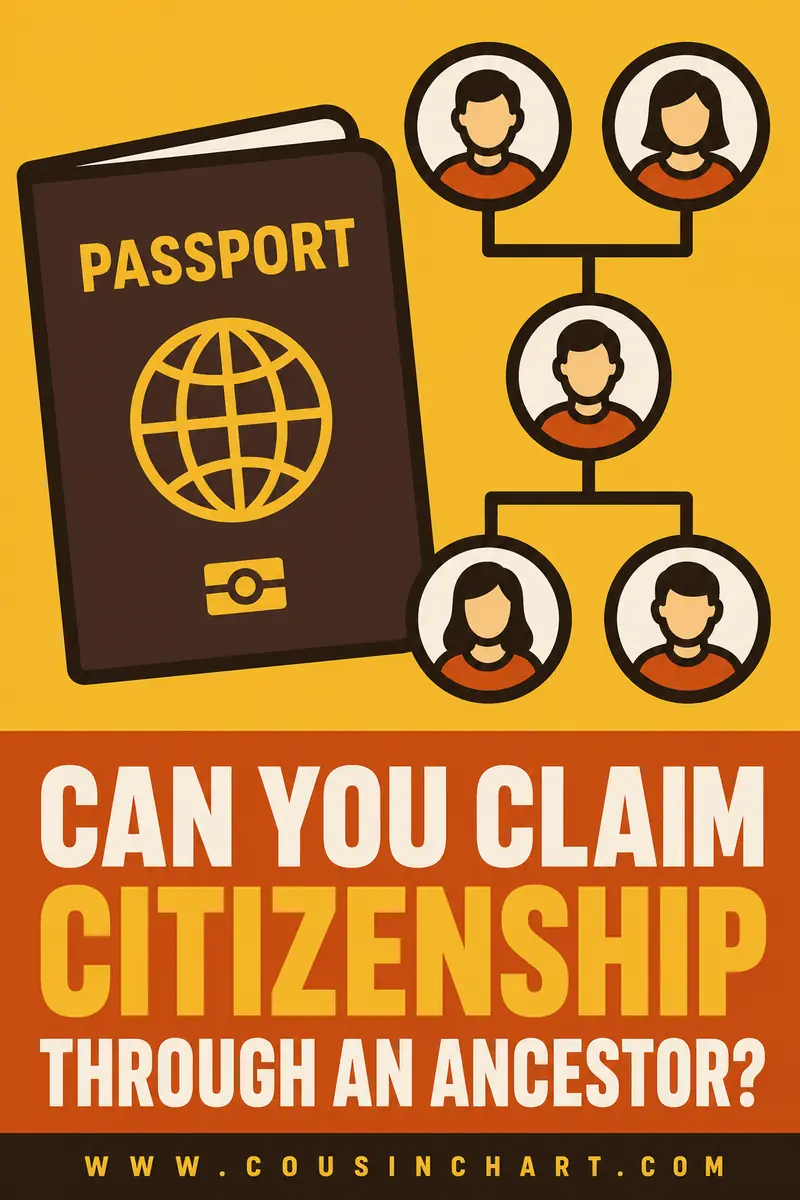
Can You Claim Citizenship Through an Ancestor?
Sometimes — and the deciding factor is almost never the one people expect. Your claim is judged against the law of that country as it stood on the day each person in your line was born, not the law as it reads today, and not how strongly you feel about the connection. A great-grandmother from Cork and a great-grandmother from Kraków can produce completely different answers, because the two countries wrote different rules and changed them on different dates. Before any of that matters, though, you need certificates for every single link in the chain. This is a records problem first and a legal one second. Start by getting the line itself straight with the cousin calculator.
How far back is your ancestor? Tap the closest match.
Tap an option above. Every claim comes down to certified records for every link in the line.
This article is general information, not legal advice. Citizenship law changes, and it varies enormously between countries — for your own case, check with that country's consulate or embassy, or a qualified immigration lawyer who works on that country's nationality law.
The two principles every country picks from
Every nationality law in the world is built on some mix of two old ideas, and knowing which one you're dealing with explains most of what follows.
Jus sanguinis means "right of blood". You are a citizen because your parent was, regardless of where you happened to be born. Most of Europe and most of Asia run primarily on this principle. It is the reason a claim through an ancestor exists at all.
Jus soli means "right of soil". You are a citizen because you were born on that country's territory, regardless of who your parents were. The United States, Canada, Mexico, Brazil and much of the rest of the Americas apply it broadly.
Nearly every country actually uses both, in different proportions. The US grants citizenship by birth on its soil and also passes it to some children born abroad. The UK once had near-unrestricted birthright citizenship and narrowed it in 1983. The mix is what matters, not the label.
The practical consequence is easy to state. If your ancestors emigrated from a jus sanguinis country to a jus soli one — Italy to Argentina, Poland to Chicago, Ireland to Boston — a descent claim may exist. The soil country made your ancestors' children citizens; the blood country may never have stopped counting them.
And it explains why this feels asymmetric. Americans routinely find they may hold a European citizenship they never knew about. Europeans almost never discover a surprise American one, because US law generally requires a qualifying parent with US residence rather than a distant ancestor.
Why the law on your ancestor's birthday is the law that counts
This is the single most misunderstood thing about descent claims, and getting it wrong wastes months.
Nationality is assessed generation by generation, at the moment of each birth. The question is not "do I qualify today". It's "did my grandmother acquire citizenship at birth under the law in force in 1931 — and did she still hold it in 1958 when my mother was born, under the law in force then?"
Which means old, repealed law still governs old births. A rule abolished in 1975 still decides what happened to someone born in 1940. Consulates and courts apply the statute that was live on the date, not the current text.
One broken link ends the chain for everyone below it. If your great-grandfather lost his original citizenship before your grandfather was born, there was nothing left to pass down, and no amount of documentation further down the line repairs it. This is the most common way claims die.
It also means dates matter more than stories. "He came over in the twenties" is not a date. The exact day of a birth, a marriage, a naturalization and a death can each swing a case, which is why certified records outrank family memory every time.
Some countries have restored rights retroactively. Others have not. Reforms sometimes reopen lines that were previously closed — and sometimes close lines that were previously open — so a "no" from ten years ago is worth re-checking, and so is a "yes".
The break in the chain that ends most claims
If a claim fails, this is usually why. It is worth understanding properly before you spend anything.
Historically, taking a new citizenship often meant losing the old one automatically. Before dual nationality became common, an emigrant who naturalized as an American, Australian or Argentine was typically treated by the old country as having given up its citizenship on that date.
So the pivotal question is a comparison of two dates: the date your ancestor naturalized, and the date their child — the next person in your line — was born. If the child was born before the naturalization, the citizenship passed. If after, it usually did not.
Wives and minor children were often swept along with the father. Under older laws in several countries, a man's naturalization could automatically cover his wife and his under-age children, which can knock out an entire branch on one date.
Which is why the naturalization file is the document you order first. In the US, that means the declaration of intention and the petition, which give the exact date of the oath. Our guide to finding US naturalization records covers where those live and how to request them.
"He never became a citizen" is a claim to verify, not to trust. Plenty of families believe an ancestor stayed a foreign national forever, and the index says otherwise. Equally, plenty of people who filed a declaration of intention never completed the process — and an incomplete file is good news for your claim.
Ask for the negative too. If no record turns up, a certificate of non-existence of record from the relevant archive is itself evidence, and several consulates specifically expect one.
What "an unbroken documented line" means on paper
Consulates do not assess your family tree. They assess a stack of certificates, and the standard is higher than genealogists are used to.
You need a birth certificate for every person in the direct line, from the emigrant ancestor down to you. Not an index entry, not a transcription, not a screenshot from a subscription website — the certified long-form certificate issued by the civil authority.
You usually need marriage and death certificates for those people too. They tie each generation to the next and prove names that changed. A woman recorded under three surnames across four documents is normal, and the marriage certificate is what stitches them together.
Names must match, or the mismatch must be explained. Giovanni becomes John, Kowalczyk becomes Kowalchik, and a clerk in 1912 spelled whatever he heard. Some consulates accept an explanatory affidavit; others require the record itself to be amended in the issuing country first, which is slow.
Foreign-issued documents generally need an apostille and a certified translation. The apostille is an international authentication stamp under the 1961 Hague Convention, added by the issuing country — in the US, usually by the Secretary of State of the state that issued the certificate. Budget time and money for both.
Certificates also have shelf lives. Several consulates will not accept a certificate issued more than three or six months before you file. Order the ancestral records early and the recent ones late.
Keep a source note for everything. Where each document came from, when you ordered it, and what it cost. If you're new to that habit, how to cite genealogy sources sets out a format that will save you re-ordering documents you already have.
Generation limits and gender rules: the two variables that decide it
There is no international standard here. The differences between countries are not small — they are the whole game.
Generation limits vary from one to unlimited. Some countries stop at a parent born there. Others recognize a grandparent. A handful have historically recognized an unbroken line of any length, provided nobody in it lost their citizenship along the way.
Residence and language conditions often appear beyond the first generation. A country may pass citizenship automatically to a child born abroad but require a grandchild to live there, pass a language test, or apply through a discretionary route instead of an automatic one.
Gender rules are the hidden trapdoor. Many nationality laws once passed citizenship through the father only. Countries corrected this at very different times, and the correction was not always fully retroactive — which is how a line through a woman can fail while the identical line through a man succeeds.
Marriage used to strip women of nationality. Under older laws in several countries, including the US between 1907 and 1922, a woman could lose her citizenship simply by marrying a foreigner. That single rule has ended more claims than most people realize.
Here is the broad shape of things. Treat it as orientation only — every one of these countries has conditions, exceptions and recent amendments that a table cannot hold.
| Country | Usual anchor generation | The thing that trips people up | Where to confirm |
|---|---|---|---|
| Ireland | Grandparent born on the island of Ireland | Registering before your own children are born | Foreign Births Register, via an Irish embassy |
| Italy | Historically an unbroken line, now tightened | Ancestor naturalizing before the next birth; pre-1948 female lines | Italian consulate for your district |
| Poland | Unbroken line, no fixed generation limit | Proving the ancestor never formally lost Polish citizenship | Provincial governor (wojewoda) office |
| Germany | Generally a parent; limited reach beyond | Complex rules for births before 1975 and restored Nazi-era cases | German missions abroad |
| Portugal | Parent or grandparent routes | Language requirement on some routes | Portuguese consulate |
| United Kingdom | Generally a parent, with narrow exceptions | Descent citizenship usually cannot pass on a second time | UK Home Office guidance |
Read that table as a prompt to ask a question, never as the answer. Rules in this area change with elections and court rulings, sometimes at short notice, and a consulate's current instructions beat anything written down anywhere else — including here.
How to test your claim in one evening, for free
Before you pay a service or a lawyer, you can usually work out whether a claim is even plausible. This costs nothing but an evening.
Write the direct line out, oldest at the top. Emigrant ancestor, then each child down to you. Names, dates and places of birth, marriage and death. Gaps are fine at this stage — you are looking for the shape.
Mark every place of birth with a country. The country where each birth happened is what turns a family tree into a citizenship question, and it is the detail people leave off.
Add the naturalization date if you have it, or a question mark if you don't. Then compare it with the next birth in the line. That one comparison predicts the outcome more often than anything else you can do at this stage.
Check the line is genuinely direct. Descent claims run through parent-to-child links only. A great-uncle's citizenship does you no good, however close the family was — see what a direct descendant is if the distinction is fuzzy.
Draw it on paper rather than in your head. A one-page printable family tree with four boxes and four dates is more useful here than a database with three thousand people in it, because it shows the whole chain at a glance.
Then check the country's own current rules. Consulate websites are the primary source and they are usually blunt about who qualifies. If your line clears the plausibility test, that is the moment to bring in professional help — not before.
What this costs, and how long it really takes
Nobody enjoys this part, but going in with honest expectations prevents most of the disappointment.
Records cost money, per certificate, in several countries. Vital record fees, apostilles, certified translations, courier postage and sometimes archive search fees all add up, and you pay them whether or not the claim succeeds.
Appointment waits are often the longest single delay. Some consulates schedule months out, and a few high-demand jurisdictions have run far longer. That queue is outside your control, which is an argument for having documents ready before a slot opens.
Processing after filing is measured in months to years, not weeks. Anyone promising a fast, guaranteed result deserves scepticism.
Professional help is optional but often worth it at the awkward links. A researcher in the ancestral country can retrieve a parish or civil record in days that would take you months by post. That is a narrow, cheap use of a professional, and different from paying for full case handling.
Beware of anyone selling certainty. The honest answer to most first inquiries is "possibly, once we see the naturalization date". If a service tells you it's straightforward before seeing a single certificate, ask what they've actually checked.
And the records are worth having anyway. Even a failed claim leaves you with certified vital records for four generations — a better documented family line than most people ever assemble. If you're unsure what to order, what vital records are and where they live is the place to start.
When the answer is no, and what to do next
A refusal is not always the end, and it is usually specific rather than general.
Find out precisely which link failed. "Not eligible" is not an answer you can act on. The date, the person and the rule that closed the line are what tell you whether anything can be done.
Missing documents are fixable; a broken chain usually is not. If a certificate cannot be found, there are often alternative proofs — church records, census entries, a court declaration of the facts. If the ancestor naturalized before the next birth, no amount of paperwork changes that.
Some closed lines have reopened through the courts. Where a rule discriminated by gender, judicial routes have existed in several countries — the pre-1948 Italian situation is the best known example, and it is set out in the Italian citizenship by descent guide.
Check the other branches. Most people have four grandparents and eight great-grandparents. Families that emigrated often did so from more than one country, and a claim that fails on one line may be perfectly sound on another.
Look at residence routes as well as descent routes. Several countries offer faster naturalization to people with proven ancestry even where automatic descent doesn't apply — a shorter residence requirement rather than an instant passport.
And consider whether you actually want it. Second citizenship can carry tax filing duties, military service obligations and other quiet commitments. Worth reading before you file, not after.
FAQ
What does citizenship by descent mean?
Citizenship by descent means acquiring a country's citizenship because an ancestor held it, rather than because you were born there. It rests on the principle of jus sanguinis, or right of blood. Eligibility depends on that country's law as it stood when each person in your line was born.
How many generations back can you claim citizenship?
It depends entirely on the country. Some recognize only a parent born there, several recognize a grandparent, and a small number have historically recognized an unbroken line of any length. Generation limits change with reforms, so confirm the current rule with the relevant consulate before relying on it.
What is the difference between jus sanguinis and jus soli?
Jus sanguinis, right of blood, grants citizenship based on a parent's nationality regardless of birthplace. Jus soli, right of soil, grants it based on birth within the country's territory. Most European and Asian countries lean on jus sanguinis; the United States, Canada, Brazil and much of the Americas apply jus soli broadly.
Does my ancestor's naturalization cancel my claim?
Often, yes — if it happened before the next person in your line was born. Under older laws, taking a new citizenship usually meant automatically losing the original one, leaving nothing to pass down. If the child was born before the naturalization date, the citizenship generally passed and the claim survives.
What documents do I need for a citizenship by descent claim?
Certified long-form birth certificates for every person in the direct line, plus marriage and death certificates linking the generations, and evidence of whether your ancestor naturalized. Foreign documents usually need an apostille and a certified translation, and several consulates only accept recent certificates.
Can I claim citizenship through a great-grandparent?
In some countries, yes; in many, no. A great-grandparent claim requires the country to recognize three generations of descent and every link in the chain to be documented and unbroken. Rules at this distance have been tightened in recent years, so check the current position directly with the consulate.
Start with the records, not the passport
The instinct is to search for the fastest route to a second passport. The better first move is dull and cheap: write out your direct line, put a country against every birthplace, and find the naturalization date. Nine times out of ten, those three facts tell you whether there is anything here worth pursuing — long before a lawyer, a fee or an appointment enters the picture. If it looks promising, the country-specific guides to Italian and Irish claims go into the detail. And if the line itself is what's tangled, sort out exactly who sits where using the cousin calculator before you order a single certificate.