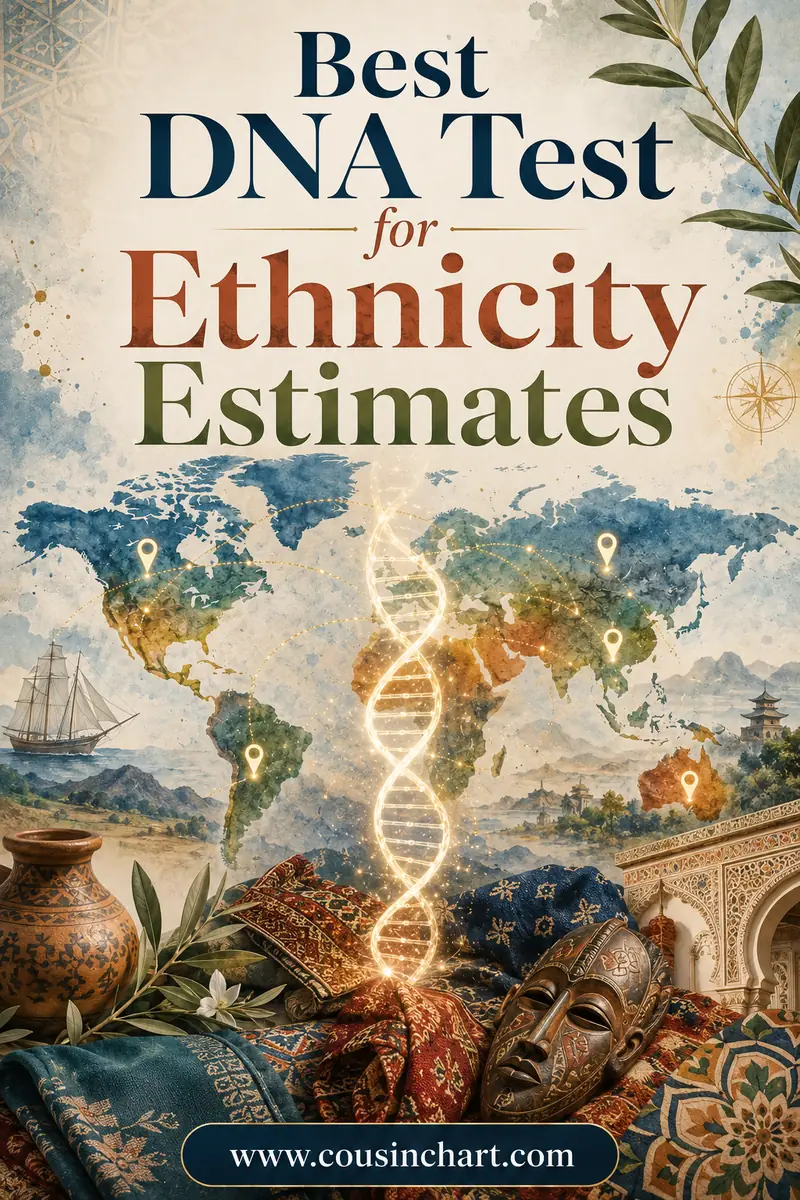
Best DNA Test for Ethnicity Estimates
There is no single best DNA test for ethnicity, because every estimate depends on the company's reference panels, and the best panels for you are the ones that cover your roots in detail. All the major tests are reliable at the continental level and softer at the country level. The right pick is the one whose reference data is strongest for the regions your family comes from.
That means the honest answer is "it depends on your ancestry," and this guide shows you how to figure out which test that points to. Just as important, it sets realistic expectations: ethnicity percentages are estimates, not measurements, so no test will hand you a certificate. When your results arrive, the free relationship calculator helps you make sense of the relatives that come with them.
Where are your roots? Tap a region for what to weigh:
Tap a region above.
See how you are related to a match →Why There Is No Universal "Best" for Ethnicity
Every ethnicity estimate works the same way: the company compares your DNA to reference panels, groups of people with deep, documented roots in one place, and estimates how much of your DNA best matches each panel. The quality of your result therefore depends on how good that company's panels are for your regions.
A company with rich, finely divided reference data for, say, the British Isles will give you sharper British results, while another with deeper coverage of West Africa or East Asia will do better there. So the "best" test for ethnicity is genuinely personal: it is the one whose reference panels best cover where your ancestors came from. That is why we cannot crown a universal winner, and why anyone who does is overselling.
The Reality Check: These Are Estimates
Before comparing companies, calibrate expectations, because this saves a lot of disappointment:
- Continental accuracy is strong everywhere. Broadly European, African, East Asian, and similar results are usually reliable on any major test.
- Country-level precision is soft. Neighboring populations share DNA, so the line between, for example, Germany and Poland, or Ireland and Scotland, is blurry and can move.
- Trace regions are the least trustworthy. A small single-digit percentage may be a real distant ancestor or statistical noise.
- Numbers update over time. As reference panels grow and algorithms improve, everyone gets re-estimated. Shifts are the science sharpening, not your DNA changing.
Our full explainer on how accurate DNA ethnicity estimates really are unpacks the machinery. Keep it in mind as you read the comparisons below: no company escapes these limits.
How the Major Tests Approach Ethnicity
AncestryDNA
AncestryDNA benefits from a very large database and a big body of reference data, and it divides many regions finely, especially for the British Isles and Western Europe. It also offers "genetic communities" that tie you to migration groups, which are directional hints rather than proof. For heavily European (particularly British and Irish) roots, its granularity is a real strength. Like all of them, its country-level splits are estimates that update.
23andMe
23andMe's Ancestry Composition is well regarded and includes a confidence slider you can set from speculative to conservative. Sliding toward conservative collapses uncertain small regions into broader, safer categories, a genuinely useful way to see which parts of your result the model is truly sure about. It also assigns maternal and paternal haplogroups, a deep-ancestry bonus other ethnicity features do not include.
MyHeritage
MyHeritage slices Europe into many regions and has an internationally tilted reference base, which some European testers find flattering in its detail, though fine splits carry the usual uncertainty. Its big practical advantage is free uploads: you can add your existing raw file and see its estimate cheaply, making it ideal for comparing estimates without a new purchase.
FamilyTreeDNA and Others
FamilyTreeDNA and smaller companies each draw their own panels, with varying regional strengths, and some (like certain regionally focused services) specialize in particular parts of the world. If your roots are concentrated in one region, it is worth checking whether a specialist panel covers it better than the big generalists.
Comparison Table
| Test | Ethnicity strength | Notable feature | Accepts uploads |
|---|---|---|---|
| AncestryDNA | Fine British/Western European detail | Genetic communities | No |
| 23andMe | Confidence slider, haplogroups | Adjustable certainty | No |
| MyHeritage | Many European regions, international | Free upload to compare | Yes |
| FamilyTreeDNA | Own panels, varies by region | Deep-line tests too | Yes |
Prices change with frequent sales; do not assume a pricier kit gives a more accurate ethnicity estimate. See our cheapest DNA tests guide.
The Smart Move: Compare Several Estimates
Because each company uses different reference panels, the most informative approach to ethnicity is to see more than one estimate. And you can do that cheaply:
- Test with one company (a big-database one like AncestryDNA is a good anchor).
- Download your raw DNA file.
- Upload it free to services that accept uploads (MyHeritage, FamilyTreeDNA, and certain third-party sites) to see their ethnicity estimates too.
When several estimates agree, that signal is solid. Where they disagree, you have found the genuinely uncertain parts of your ancestry, usually the fine country-level splits. Seeing the spread is far more honest than trusting one company's numbers as gospel. Our three-way comparison shows how the big three tend to differ.
What Makes One Panel Better Than Another for You
Since it all comes down to reference panels, it helps to know what makes a panel strong for a given region. Two things matter most:
- Number of reference people from that region. More documented reference samples with deep local roots means the algorithm has a richer picture to compare you against, and a sharper result.
- How finely the region is divided. A company that treats "Europe" as one block gives you a coarse answer; one that splits it into a dozen sub-regions can, in principle, tell you more, though finer splits also carry more uncertainty.
The practical implication: before buying for ethnicity, look at each company's published region list and find the areas your family comes from. If a company lists your specific region as its own category rather than lumping it into a big continental bucket, that is a sign its panels cover you well. A company with strong overall reference data but no dedicated category for your region will give you a vaguer answer than one that specifically covers it. This quick check is more useful than any general "best ethnicity test" claim, because it answers the only question that matters: best for whom.
Ethnicity Is Not the Same as Heritage or Identity
One honest caution that saves a lot of heartache: a DNA ethnicity estimate is a statistical comparison to reference populations, not a measure of your culture, nationality, or who you are. Someone raised deeply in a culture may see little of it in their DNA estimate, and someone may carry DNA resembling a region their family never identified with. Neither result changes their heritage or identity.
Read ethnicity estimates as a scientific pointer to where some of your ancestors likely lived, useful for research and curiosity. Do not let a percentage, especially a soft country-level or trace figure, overwrite a lived family story or become an identity claim it was never designed to support. The numbers are a starting point for discovery, not a verdict on belonging.
Why the "Best" List Keeps Changing
If you search for the best ethnicity test, you will find different answers from different years and different reviewers, and there is a genuine reason beyond marketing. Ethnicity accuracy hinges on reference panels, and every company keeps expanding and reshaping its panels. A service that was thin on a region two years ago may have added many reference samples since, sharpening its results there. Another may have overhauled its algorithm and re-drawn its region map entirely.
So a "best test for ethnicity" verdict has a short shelf life. What stays true is the method for choosing well: identify your regions, check which company lists them as dedicated categories with deep reference data, and compare a couple of estimates via free upload rather than trusting one. That approach outlasts any specific ranking, because it adapts as the companies change. Chasing last year's winner can point you at a test that has since been leapfrogged for your particular ancestry, while the method always points you at what is best for you right now.
Matching the Test to Your Roots
- British/Irish and Western European roots: AncestryDNA's fine regional detail is a strength; compare with MyHeritage via upload.
- Broad European roots: MyHeritage's many European regions and free uploads make comparing easy.
- African, Asian, or Indigenous roots: check each company's region list for your specific areas, since coverage varies widely; a specialist panel may serve better.
- Mixed / admixed roots: expect country-level fuzziness everywhere; trust continental signals and compare several estimates.
- Just want a broad picture: any major kit on sale gives reliable continental results.
If finding relatives matters as much as ethnicity, weigh this against our best DNA tests for ancestry guide, since the best ethnicity fit is not always the best matching fit.
FAQ
What is the best DNA test for ethnicity?
There is no universal best, because ethnicity accuracy depends on each company's reference panels for your specific regions. All major tests are reliable at the continental level and softer at the country level. The best one for you covers your roots in the most detail, so match the test to where your family comes from.
Which DNA test is most accurate for European ancestry?
AncestryDNA and MyHeritage both divide Europe finely and are popular for European roots, with Ancestry especially strong for British and Irish detail. Fine splits are still estimates, so compare several by uploading your raw file to more than one service.
Why do different DNA tests give different ethnicity results?
Because each company uses its own reference panels and algorithms, so the same DNA produces different estimates. None is the single true answer; they are estimates of the same ancestry. Continental signals tend to agree; fine country-level detail is where they diverge.
Can I compare ethnicity estimates without buying several kits?
Yes. Test with one company, download your raw DNA file, and upload it free to services that accept uploads to see their estimates too. Where multiple estimates agree, the result is solid; where they disagree, you have found the uncertain parts.
Does a more expensive test give a more accurate ethnicity estimate?
No. Price reflects features, database access, and sales timing, not ethnicity accuracy. Every estimate is limited by reference panels, which a higher price does not fix. Buy on sale and compare estimates instead.
How accurate are the small trace percentages?
They are the least reliable numbers. A single-digit trace region may be a real distant ancestor or statistical noise, and it often changes or disappears with updates. Do not build a family story on a trace region without other evidence.
The Bottom Line
The best DNA test for ethnicity is the one whose reference panels best cover your roots, so the answer is personal, not universal. Every major test is strong at the continental level and softer at the country level, and the same DNA yields different numbers across companies because each uses its own panels. The smartest approach is to test once and upload your raw file to compare several estimates for free, trusting where they agree and treating trace regions with caution. And when the relatives that come with your results leave you puzzled, the free family relationship calculator turns shared DNA and a family detail into the correct relationship name in seconds.