100 Family History Interview Questions
The hardest part of interviewing a relative is not finding questions. It is that the obvious ones — "what was it like growing up?" — produce a shrug and "oh, it was fine". Specific questions get stories; general questions get summaries. Ask what was in the kitchen, what a week's wages bought, what the house smelled like on a Sunday, and the same person who had nothing to say will talk for an hour. Below are a hundred questions grouped by topic, plus the follow-up phrases that do most of the real work. To sort out any relationship that comes up while you listen, use the cousin calculator.
Where do you want to start? Tap a topic.
Tap a topic above. Specific questions get stories; general ones get shrugs.
Before you press record
Six minutes of preparation that changes what you get.
Record it. A phone on the table is enough. Notes preserve facts; a recording preserves the voice, the laugh and the pauses, and in twenty years that is the part the family will care about.
Ask permission at the start of the recording, on the recording. "Is it all right if I record this?" It settles consent and dates the file.
State the date, place and names in the first ten seconds. Every archivist wishes more people did this.
One session, forty to sixty minutes. Beyond that, both of you tire and the answers get shorter. Two good short sessions beat one exhausting one.
Do not work through this list in order. Pick eight or ten questions, follow whatever the answers open up, and keep the rest for next time.
Bring photographs. A photograph in someone's hand produces more detail than any question — and while they hold it, write on a separate slip who is in it, not on the back of the print itself, for the reasons set out in how to preserve old family photos.
And let silence sit. The pause after an answer is where the second, better answer arrives. The full method is in how to interview a relative.
Beginnings and family facts
The anchoring questions, useful for the record even when the answers are brief.
- What is your full name, and were you named after anyone?
- Did you have a nickname, and who gave it to you?
- When and where were you born?
- What do you know about the day you were born?
- What were your parents' full names, including your mother's maiden name?
- When and where were your parents born?
- How did your parents meet?
- What were your grandparents' names, and what do you remember about them?
- Did you know any great-grandparents, or hear stories about them?
- How many brothers and sisters did you have, and where did you come in the order?
- Which relative were you closest to as a child?
- Was there a relative everyone talked about, and what was the story?
- Where did the family come from originally, as far as you were told?
- Are there family names that keep repeating down the generations?
- Who in the family kept the papers, photographs and the family Bible?
Childhood and home
Where the best material almost always is.
- What is your earliest memory?
- Describe the house you grew up in, room by room.
- Did you have your own bedroom, or share?
- What did the house smell like?
- Was there electricity, running hot water, an indoor lavatory, a telephone?
- How was the house heated, and whose job was the fire?
- What did you eat on an ordinary weekday?
- What did Sunday dinner look like?
- What was your job in the house, and from what age?
- What did you do after school before television?
- What games did you play in the street?
- Did you have a bicycle, and where were you allowed to go on it?
- What pets were there?
- What did you get for Christmas or your birthday as a child?
- What were you frightened of?
- What did you get in trouble for?
- What is something that was ordinary then and does not exist now?
- What sounds do you associate with your childhood?
School and growing up
Usually vivid, and easy ground for someone who says they have nothing to tell.
- Where did you go to school, and how did you get there?
- What do you remember about your first day?
- Which teacher do you still remember, and why?
- What were you good at, and what did you dread?
- Were you ever punished at school?
- What did you wear — uniform, hand-me-downs, shoes in summer?
- What did you carry your lunch in, and what was in it?
- At what age did you leave school, and was that your decision?
- Who was your best friend, and what happened to them?
- What did you want to be when you grew up?
- What did you do for fun as a teenager?
- What music were you listening to at sixteen?
- What did your parents disapprove of?
- When did you first feel grown up?
Work and money
Concrete questions that produce dates and places as well as stories.
- What was your first paid job, and how old were you?
- What did it pay, and what did a loaf of bread cost then?
- What did you do with your first wages?
- How did you learn the work — apprenticeship, training, watching someone?
- Describe an ordinary working day from waking up.
- What did you wear to work?
- How did you get there?
- Who did you work with, and are you still in touch?
- What was the hardest job you ever had?
- What work did your father and mother do?
- Was there a family trade or business?
- Did you ever have to move for work?
- What did you retire from, and how did it feel?
- What is the biggest change in that kind of work since?
Love, marriage and children
Frequently the questions people most enjoy being asked.
- How did you meet your husband or wife?
- What was your first impression of them?
- Where did you go on your first date, and what did it cost?
- How long before you married, and who proposed?
- Describe the wedding — where, who came, what you wore.
- Did you have a honeymoon?
- What was your first home together like, and what did it cost?
- What did you argue about in the first year?
- When was your first child born, and where?
- What do you remember about becoming a parent?
- How did you choose your children's names?
- What was the hardest part of raising a family?
- What did you want to do differently from your own parents?
- What do you think you got right?
Place, migration and belonging
The questions that connect a person to a map, which is what makes records findable.
- What are all the places you have lived, in order?
- Which one felt most like home?
- Why did the family leave the place they came from?
- Who was the first to move away, and what happened to them?
- Did anyone emigrate, and did you hear from them?
- What languages were spoken at home or by older relatives?
- What did the neighbors do for a living?
- How has the place you grew up in changed?
- Is there a building, a street or a grave I should go and see?
Beliefs, traditions and hard times
Ask these later in the session, once the conversation is running.
- What role did religion play in the household?
- What traditions did your family keep that others did not?
- What recipes should not be lost?
- What superstitions or sayings did your mother or grandmother have?
- Do you remember where you were when you heard important news?
- What do you remember about the war years?
- Did anyone serve, and what did they say about it afterwards?
- Was there a time when money was very short, and how did the family manage?
- What was the hardest thing you have lived through?
- Who did you lose that you still think about?
- Was there a family disagreement that lasted, and do you know how it started?
- What did you worry about that turned out not to matter?
- What are you proudest of?
- What advice would you give your twenty-year-old self?
- What do you want your great-grandchildren to know about you?
- What have I not asked that I should have?
Question one hundred is the most productive on the list. Ask it every time, and expect the answer to be better than anything you planned.
The follow-ups that do the real work
Six phrases that turn a short answer into a story.
| Instead of | Say |
|---|---|
| Moving to the next question | "What happened next?" |
| "That's interesting" | "What did that look like?" |
| Accepting a summary | "Can you give me an example?" |
| A closed yes/no | "How did you feel about that?" |
| Filling a silence | Nothing. Wait. |
| "Are you sure?" | "How do you remember it?" |
"Tell me about a time when…" beats any question starting with "did". It cannot be answered in one word.
Ask for the senses. What it looked, smelled and sounded like recovers memories that direct questions do not reach.
Never correct them mid-answer, even when a date is plainly wrong. Note it and check the record later; correcting someone is the fastest way to end a good interview.
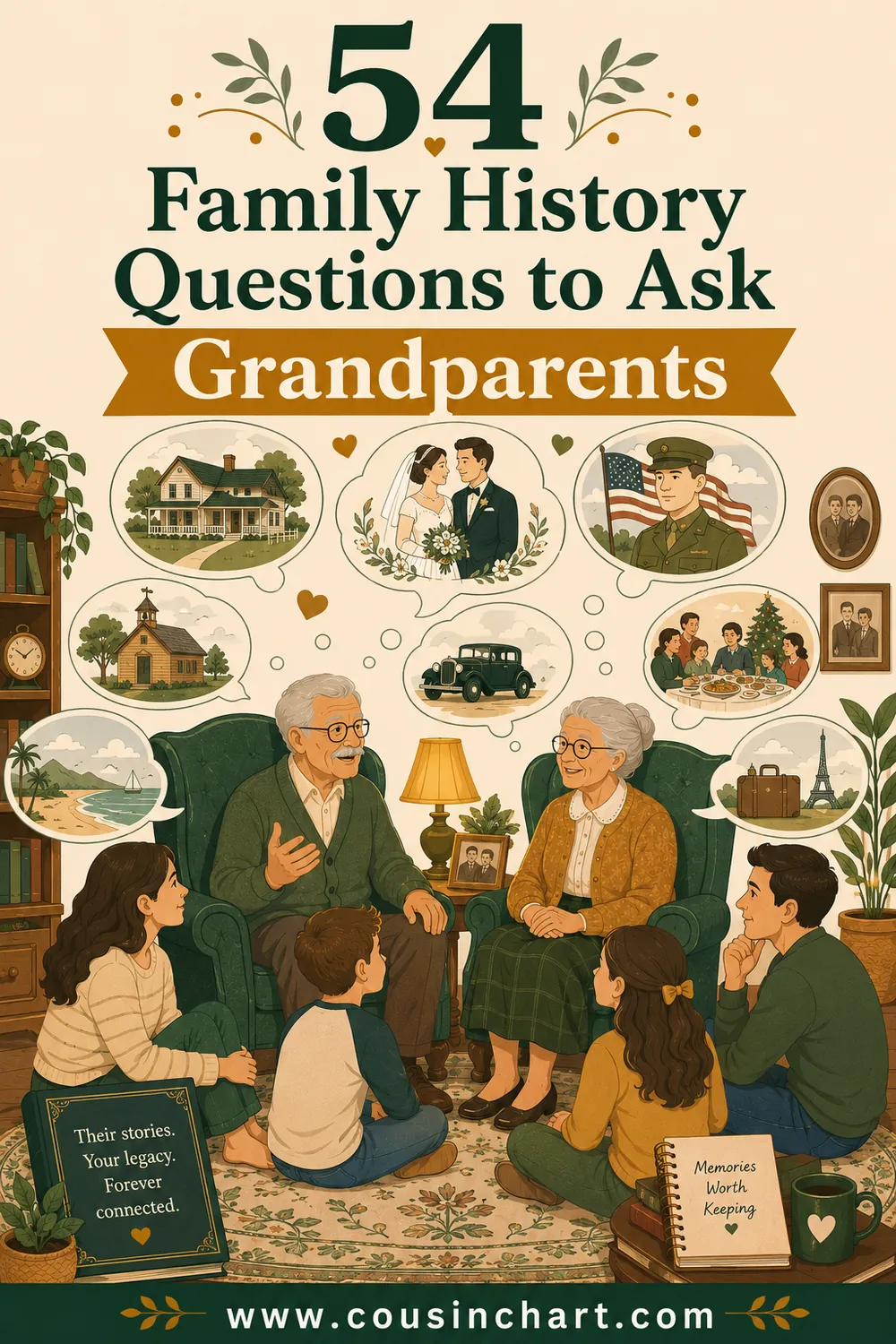
For a grandparent specifically, a shorter and gentler starting set is in questions to ask grandparents.
And ask the same question again in a later session. Second tellings are consistently richer, and the differences between the two are informative in themselves.
Afterwards
What to do in the week following, while it is fresh.
Back the recording up twice the same day, in two places.
Label the file properly: name, date, place. "Margaret Hall interview, 14 March 2026, Norwich."
Write a summary with timestamps rather than a full transcript. Ten minutes of "04:12 — first job at the mill" makes a two-hour recording usable forever.
Check the facts against records — the dates, spellings and places are leads, not conclusions.
Send them something back. A photograph of a record you found, or a printed page of what they told you. It is a courtesy, and it is why the second interview happens.
Ask about documents and photographs while you are there, and scan rather than borrow, using the approach in how to digitize family documents.
And write it up sooner than feels necessary. The recordings are raw material; the version that gets read is the written one, whether that is a short profile or the structure set out in family history book template and how to write a family history.
FAQ
What are the best family history interview questions?
Specific ones. "What did you eat on an ordinary weekday?" and "what did your first wages buy?" produce stories, where "what was it like growing up?" produces a shrug. Sensory and concrete beats broad and reflective every time.
How long should a family history interview be?
Forty to sixty minutes. Beyond that both people tire and answers shorten. Two shorter sessions get better material than one long one, and the second is almost always richer than the first.
Should I record the interview?
Yes, on a phone if that is what you have. Notes keep facts, but a recording keeps the voice, and ask permission on the recording itself so consent and date are captured together.
How do you get someone to open up?
Start with childhood and home, which are safe and detailed, bring photographs to hold, and leave silences unfilled. The pause after an answer is where the better answer arrives.
What if they get a date or a name wrong?
Note it and check the record afterwards rather than correcting them during the interview. Memory is a lead, not evidence, and correcting someone mid-answer usually ends the flow for good.
What should I ask an elderly relative first?
Their full name, where they were born, and their earliest memory. It settles the recording's essential facts and opens onto the childhood questions, which are the most productive ground on any list.
Ask small, listen long
A hundred questions is far more than any single sitting needs. Choose eight, start with childhood and home, and follow whatever the answers open rather than working down the list. Record it, say the date and names at the start, keep it under an hour, and let the silences sit. Then ask question one hundred — what have I not asked that I should have — because the answer is routinely better than anything on the sheet. Back the file up the same day, write a timestamped summary while it is fresh, and go back for a second session. And when a relationship comes up mid-story that nobody can quite name, the cousin calculator will settle it.